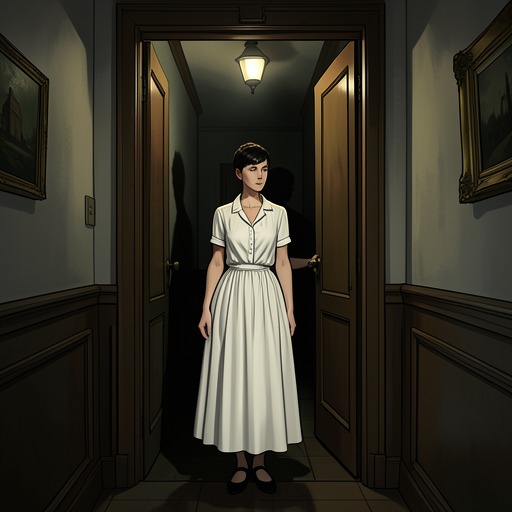
The inside-out motif
Other PeopleThe inside-out motif gives bodily form to the return of the past in Mary Lamb / Amy Hide’s experience. Across episodes of disturbance, remembered violence, self-protection, and identity shock, the image suggests that what has been buried cannot simply be kept outside the present: it comes back and changes how she inhabits herself.
The Past as an Invasion
After a night she cannot fully account for, Mary Lamb / Amy Hide senses that something has happened while she slept. She understands the change through the image of being turned inside out, as though the past had waited until she was helpless before returning. The thought that she both brought the violence about and wanted more complicates the image: the past is experienced as an invading force, yet her response also implicates her in its recurrence.
The motif therefore makes memory feel physical before it becomes coherent knowledge. Mary Lamb / Amy Hide cannot initially assemble what happened into a stable account; the disturbance is registered as a change to the self. The image gives that unassimilated experience a shape while preserving its uncertainty.
Repetition and Recognition
When Mary Lamb / Amy Hide later recalls the night of Trev’s assault, the memory returns in broken images rather than as a continuous narrative. During the episode, she recognizes an echo of an earlier experience involving Sharon, but recognition does not make the present event easier to understand or endure. The repeated pattern suggests that the past is not safely over: it presses into a new moment, where its recurrence is felt through the body before it can be fully explained.
The motif also marks a shift from helplessness toward action. After Trev leaves her vulnerable, Mary Lamb / Amy Hide decides to defend herself when she hears him waking and strikes him with a brick. The reversal does not erase what has happened; it shows that the same night in which the past seems to overwhelm her also contains an act of resistance.
Identity and Bodily Rejection
The image returns in a different form after Mary Lamb / Amy Hide confronts a photograph of a face that resembles hers but seems older and unfamiliar. Her recognition brings not reassurance but nausea and a fearful question about her life. She becomes physically sick, as if the self she had believed in cannot contain what the image suggests.
Here, being turned inside out connects bodily distress with the problem of personal identity. The photograph unsettles the boundary between the person Mary Lamb / Amy Hide thinks she is and the history that may belong to her. Her response is not a completed discovery but an acute rejection of an unknown past that has become difficult to keep at a distance.
Motif and Narrative Effect
Across these episodes, the inside-out image links a night of incomprehensible disturbance, a fragmented return of earlier experience, an act of self-defense, and a later crisis of recognition. Its force lies in the changes between them: bodily vulnerability can give way to resistance, while apparent recognition can produce renewed disorientation.
The recurring image makes the past an active pressure rather than a settled record. It also gives the narrative a way to register trauma without reducing it to orderly explanation: the body reacts, memory arrives in pieces, and understanding remains unsettled. The motif’s repeated reversals thus mirror Mary Lamb / Amy Hide’s unstable sense of where her past ends and her present self begins.